This post is a little different from what I usually share here. Most days I’m talking about homeschool ideas, learning activities, and ways to keep your busy kids occupied.
But sometimes real life hands you a lesson that doesn’t come with a worksheet.
This Valentine’s Day, I gave my husband a portrait of our dog, Kallie. I had looked at that photo a hundred times before giving it to him, but seeing it hanging on the wall hit differently.
🎉 Get $20 Off Outschool Classes!


A couple months ago, we lost her after thirteen and a half years together. She passed peacefully in her sleep at home. It was unexpected in the moment, but it was the best way it could have happened.
The quiet afterward has been loud, though.
And standing there looking at that portrait, I realized something.
As a homeschool parent, I spend a lot of time thinking about what I’m responsible for teaching. Reading. Writing. Math. Life skills. Emotional regulation. Character. All of it.
But grief?
Grief doesn’t come with a lesson plan.
You can’t pre-teach it.
You can’t practice it ahead of time.
You can’t soften it with a unit study.
It just shows up.
A Child Who Has Known Loss
If anyone has already walked through more grief than most adults, it’s my daughter.
Loss has been part of her story from the very beginning.
Emily’s birth mother died two days after she was born. Because of complications Emily was having at birth, she was transferred to a different hospital’s NICU almost immediately and was only held by her birth mother for a total of maybe two minutes. We learned during adoption classes that even newborns can experience separation and loss, even if they can’t communicate it.
When Emily was about 6 months old, my parents became her daycare providers and saw her almost every day of her life until she was six years old. Then they moved to another state way across the country. When they left, it felt to her like something had been ripped away. And every visit since comes with another goodbye that breaks her heart all over again.
She’s lost our cat Marley, who was one of her first BFFs.
A couple years ago, she lost a friend her age to cancer.
And now she’s lost Kallie, who’s been by her side for more than nine years.
That’s a lot of grief for one small human.
And yet.
When Kallie died, Emily had been worried for months about what it would feel like when the day finally came. The idea of experiencing death firsthand scared her now that she was at an age to fully understand it.
But when it happened, something unfolded that I don’t think either of us expected.
Because Kallie passed peacefully at home, Emily was able to sit with her. She talked to her. She said goodbye in her own way. There was no rush. Just quiet moments.
The next morning, she woke up with purpose.
Not because she wasn’t sad. She absolutely was. But because she knew what she needed to do.
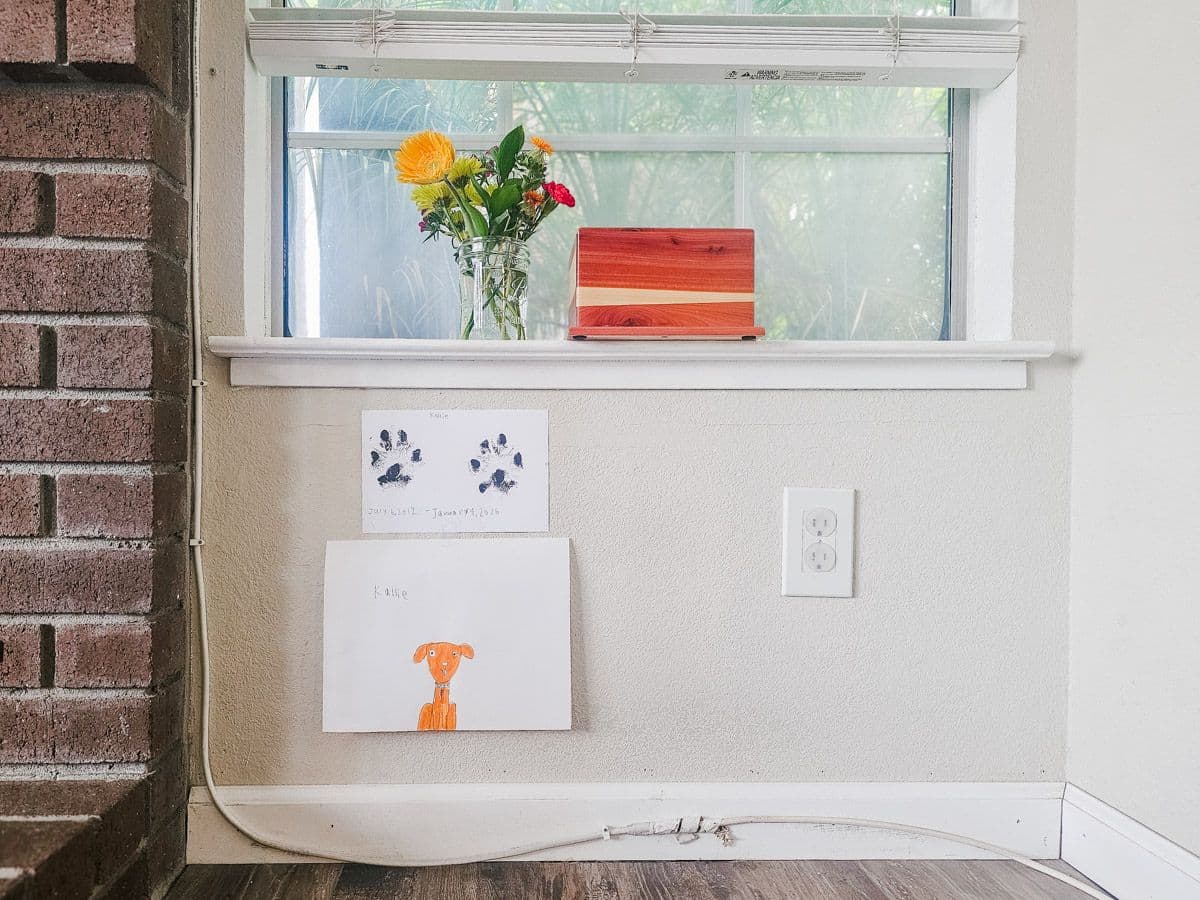
She went straight to her art supplies and made a memorial poster for Kallie. Then she taped it to the wall right above where the dog bed had been.
This wasn’t new behavior.
When Marley died a few years ago, she drew pictures of him and made drawings for me to help me feel better.
When her friend passed away, we were in the middle of a poetry lesson during our school day. She stopped, looked at me with excited energy, and said she needed to write something. She wrote the sweetest, deepest poem about her friend. It didn’t feel like a school assignment. It felt like healing.


What She’s Taught Me About Grief
This is what I’ve started to understand watching her.
I can’t teach her how to grieve.
I can be honest.
I can answer hard questions. Plus the questions that might sound weird, inappropriate, or morbid. Because she’s human and curious and those answers bring closure.
I can sit next to her when she cries. And cry right along with her.
I can let her feel what she feels without trying to rush it away.
But I cannot hand her a formula for loss.
And maybe I’m not supposed to.
What I’ve learned from her is that grief doesn’t have to cancel out joy.
She cries while remembering funny stories.
She misses someone deeply and still laughs an hour later.
She feels the sadness fully — and then creates something beautiful right alongside it.
She doesn’t seem to believe that happiness is disrespectful to grief.
She holds both.
Somehow, she balances the weight of loss with happiness.
And watching her has changed me.
I used to think healing meant getting to the point where the sadness didn’t feel so heavy anymore. Like the goal was to move past it.
Now I think healing might look more like learning how to carry it while still letting yourself feel happy.
If anyone has been through it, it’s this kid.
And she still chooses light.
That poster of Kallie is still taped to the wall where her dog bed used to be.
And every time I walk past it, I smile. It reminds me that grief and joy are not opposites.
Sometimes they live in the same space.
If You’re Walking Through Grief With Your Child
If you’re navigating loss with your child right now, whether it’s the death of a pet, a family member, or another kind of goodbye or loss, know that there isn’t one right way to handle it.
Their reaction might be unpredictable, to you and to them.
The best thing we can do is be honest, be present, and allow room for their feelings without rushing them past it.
One simple thing that has helped in our house is having those art supplies always available and seeing what happens. No assignment. No instructions. Just paper, markers, paint, and…space. Sometimes what comes out says more than a conversation ever could.
And if your child laughs, smiles, or seems okay in a moment that feels heavy to you, try not to assume they aren’t grieving. Sadness can feel overwhelming, especially for kids who feel everything intensely. Sometimes laughter shows up not because the loss doesn’t matter, but because their nervous system needs a break.
Kids can’t separate their emotions into neat categories. They can miss someone deeply and still laugh at a memory five minutes later. They can cry and then go play.
That doesn’t mean the grief is gone.
It just means they’re balancing it in their own way, like Emily does.
Books That Also Helped Our Family
A quick note: this section contains Amazon affiliate links, which simply means I may earn a small commission if you choose to purchase through them. It doesn’t cost you anything extra, and I only ever share things that we use and have genuinely helped our family.
If you need help with a gentle way to talk about loss with your child, these books mean a lot to us:
- The Rainbow Bridge by Adrian Raeside
- Dog Heaven by Cynthia Rylant
- The Invisible String by Patrice Karst
I purchased The Rainbow Bridge after we lost our cat, Marley. He died pretty traumatically and while Emily was old enough to understand he wasn’t coming back, this book explained pet loss in a hopeful way without minimizing the sadness. It still brings us comfort in knowing someday we will see our pets again.
We received the book Dog Heaven from a dear, anonymous soul a couple of weeks after we lost Kallie, and I am so grateful they sent it! It’s a light read about some great ways dogs spend their eternity in heaven. The book is full of bright, colorful illustrations and had us smiling the whole time.
The Invisible String is a book I purchased during 2020 COVID days when we couldn’t see our family, and we’ve re-read it multiple times over the years when something tough comes along. It’s been helpful when someone we love has passed away and it was also very helpful when my parents moved. I appreciate this book because it’s not just about grief and loss. It’s a story that shows us that love doesn’t disappear just because someone, or something, is far away or gone.

